
Salesforce Agentforce marks the next big leap in AI, autonomous agents that don’t just respond like copilots, but actually reason, plan, and act on your behalf. Think of them as digital teammates who can qualify leads, resolve service cases, optimize campaigns, or even coordinate across multiple systems, all while staying grounded in trusted Salesforce data.
Unlike earlier chatbots or copilots, Agentforce isn’t limited to “answering a query.” It uses the Atlas Reasoning Engine to break down tasks, pull data in real-time, plan step-by-step actions, and execute them without needing human babysitting. This makes it a genuine shift from assistive AI to autonomous AI.
Why Agentforce Stands Out?
- True Autonomy: Copilots suggest. Agents act. Within guardrails you define, Agentforce agents make independent decisions and complete workflows end-to-end.
- Advanced Reasoning: Powered by Atlas, they analyze context, fetch the right data, and execute in sequence. Early benchmarks show higher relevance and accuracy compared to traditional copilots.
- Continuous Improvement: With telemetry and feedback loops, agents refine future decisions based on past outcomes.
The Five Core Attributes of an AI Agent
Every Agentforce agent is built from these attributes:
- Persona – Defines the role, such as Service Agent or Sales Coach.
- Topics & Instructions – Scopes of work plus detailed guardrails (“Always escalate billing disputes to finance”).
- Data Access – Agents tap directly into Data Cloud for live, trusted business data.
- Actions – From updating records to calling an external API.
- Guardrails – Safety boundaries to enforce compliance and trust.
This structure ensures agents aren’t just “chatty assistants” – they operate with context, compliance, and clarity.
https://www.salesforce.com/agentforce/guide
How Agentforce Works: The Workflow
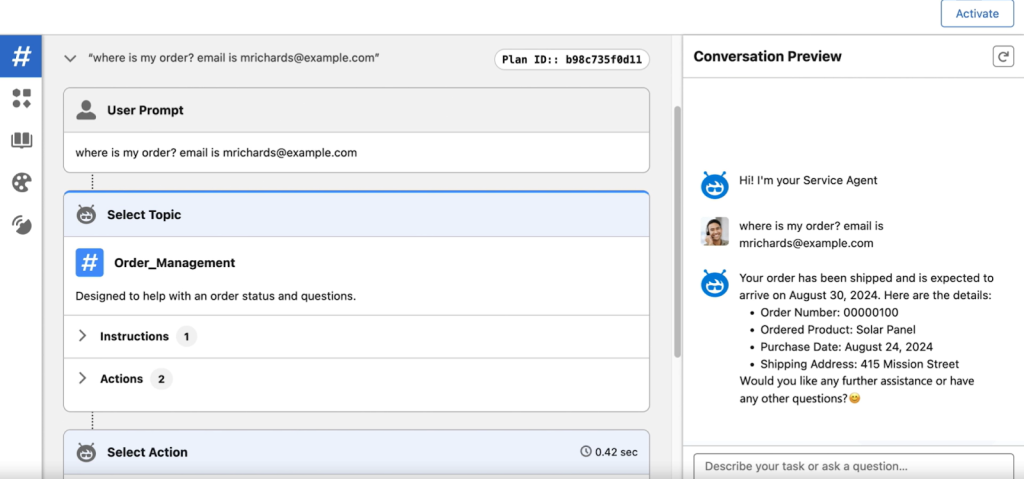
Here’s the simplified reasoning loop agents follow:
- Input Processing – Capture user intent and context.
- Topic Matching – Map intent to the right topic domain.
- Instruction Analysis – Apply agent-specific rules and guardrails.
- Data Retrieval – Pull relevant records from Salesforce or integrated apps.
- Plan Building – Break tasks into logical steps.
- Execution – Perform flows, send emails, call APIs, update records.
- Learning – Log outcomes, feed telemetry, improve over time.
https://www.salesforce.com/au/agentforce/how-it-works
Atlas Reasoning Engine: The Brain Behind Agentforce
Atlas isn’t just an engine – it’s the strategic core powering Agentforce autonomy. Developed by Salesforce AI Research, Atlas dramatically raises the agentic bar for contextual understanding, accuracy, and safe automation.
What Sets Atlas Apart?
Traditional bots react with scripted “System 1” responses. Atlas uses “System 2” reasoning: it unpacks real user intent, evaluates business context, plans steps, and asks for clarification when needed. Pilot studies show Atlas-powered agents deliver up to 2x higher relevance and 33% better accuracy than standard copilots (based on Salesforce enterprise benchmarks).
The ReAct Loop: Reason, Act, Observe
Atlas operates on an iterative Reason-Act-Observe (ReAct) loop:
- Reason: Breaks requests into subtasks, determines needed data and actions using enterprise rules and recent outcomes.
- Act: Invokes Salesforce flows, APIs, or record updates, utilizing both structured Data Cloud and unstructured assets (emails, PDFs, knowledge).
- Observe: Validates outcomes, revises plans, escalates to humans if confidence is low or compliance policies require hand-off.
This flexible approach lets Atlas resolve issues (like a delayed order or password reset) by combining context analysis, retrieval, and proactive next steps – all without pre-scripted rigid flows.
Topic Classification, Guardrails, and Scope Management
Atlas precisely classifies requests using natural language processing – scoping each interaction to a specific business topic. Each topic defines allowed actions, compliance guardrails, and relevant systems. Limiting agents to 15 topics, each with 15 actions, keeps reasoning tight and safe.
Retrieval-Augmented Generation (RAG) and Data Integration
Atlas leverages RAG to ground every action in real Salesforce business data:
- Query Refinement: Enriches user requests with context, IDs, metadata.
- Semantic Search: Uses vector embeddings and knowledge graphs for relevant data across Data Cloud and integrated platforms.
- Parallel and Multi-Intent Handling: Recognizes complex requests, retrieves simultaneous data streams, and composes a unified answer.
- Content Grounding and Provenance: Every reply is verified and audited against enterprise data, nearly eliminating hallucinations.
Admins can use no-code retrievers to configure data access, ensuring fast, reliable integration – no advanced vector code required.
Transparent Reasoning, Trust Layer, and Hallucination Prevention
Atlas displays its reasoning steps in real-time (visible “thought process”), helping users trace logic and administrators audit compliance.
- Einstein Trust Layer: Every action is rigorously filtered for toxicity, PII violation, and policy breaches – all logged for compliance review.
- Grounding Checks: Atlas confirms response accuracy before proceeding and escalates if low-confidence, keeping interactions enterprise-safe.
Adaptive Learning: Reinforcement from Outcomes
Atlas applies Reinforcement Learning from Customer Outcomes (RLCO):
- It analyzes business results (resolved cases, converted leads, campaign success) to improve future recommendations.
- Data privacy controls ensure your learning signals remain proprietary.
Integration Across Ecosystem
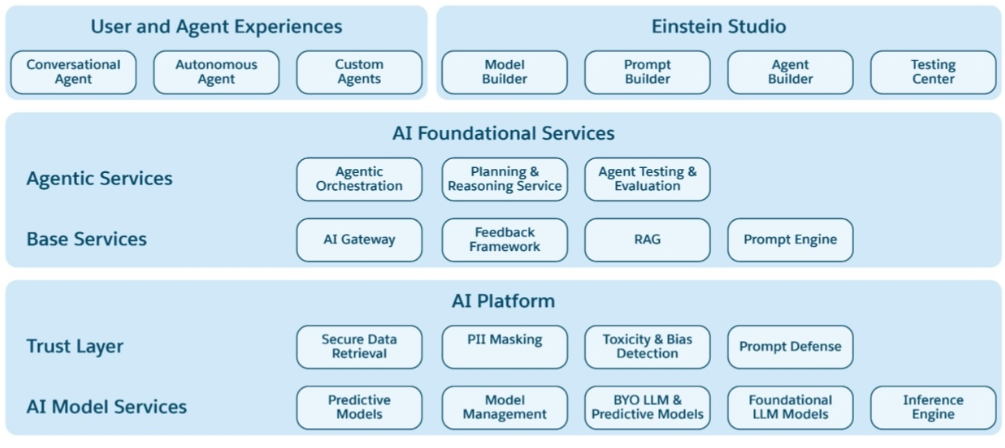
Atlas works seamlessly with Salesforce’s Agentforce stack:
- Einstein Trust Layer for security and compliance
- Data Cloud for unified access
- Model Context Protocol (MCP) for governance
- Agent Builder for low-code control
- Multi-Agent Orchestration for coordinating complex business processes
Real Impact for Enterprises
With Atlas, agents require less supervision, handle multi-step workflows, adapt to new business challenges, and provide an audit trail for trusted, scalable automation. Real deployments show rapid value delivery across industries – from financial services to retail, healthcare, and manufacturing.
Pre-Built Agents You Can Deploy Today
Salesforce offers a starter set of agents you can use immediately and customize:
- Service Agent – Handles support cases and escalations.
- SDR Agent – Qualifies leads, schedules discovery calls.
- Sales Coach – Provides on-the-fly guidance for reps.
- Merchant Agent – Manages orders and product recommendations.
- Campaign Optimizer – Tweaks campaign performance in real-time.
- Personal Shopper – Suggests tailored product bundles for customers.
These out-of-the-box agents lower the barrier to adoption, you can deploy one quickly, then fine-tune for your industry needs.
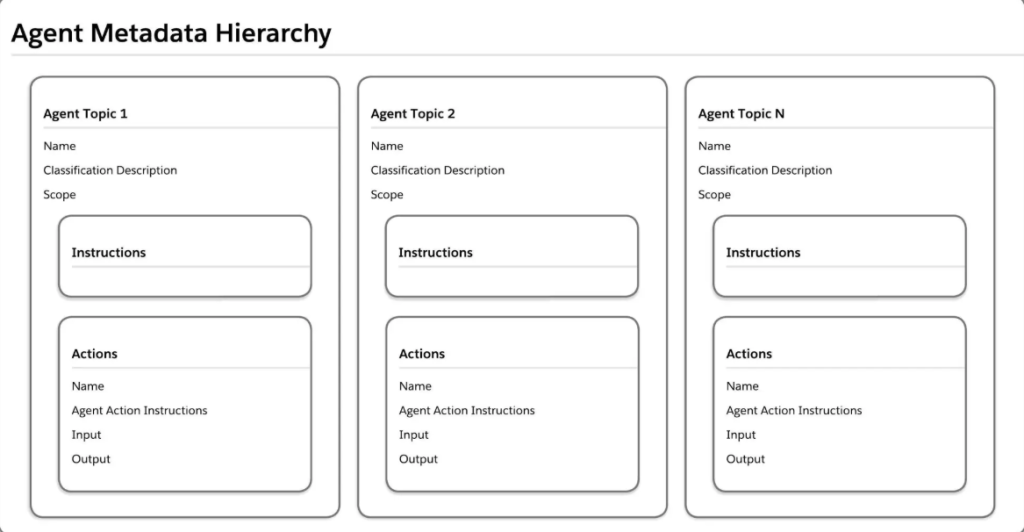
Topics & Actions: The Building Blocks
- Topics define the scope (e.g., Order Management). Each topic comes with classification criteria and instructions.
- Actions are the hands-on tasks:
- Standard actions (queries, updates, email)
- Custom actions (Flow, Apex REST, external API calls, Prompt Templates)
- Pro Tip: Keep things manageable. Limit to 15 topics per agent and 15 actions per topic. This keeps reasoning tight and avoids runaway complexity.
Building Custom Agents with Agent Builder
The Agent Builder gives you a guided, low-code experience:
- Define the Job – Describe the agent’s role in natural language.
- Reuse Logic – Pull in existing Flows, Apex code, or APIs.
- Set Topics & Actions – Agentforce recommends based on your org’s metadata.
- Establish Guardrails – Write “always/never” rules to enforce compliance.
- Test & Deploy – Validate reasoning chains, simulate scenarios, and then publish.
Agentforce vs. Einstein Bots
| Feature | Agentforce | Einstein Bots |
| Autonomy | Independent, multi-step execution | Scripted flows, human-guided |
| Reasoning | Atlas engine, contextual reasoning | Pattern-matching intents |
| Data Access | Real-time from multiple systems | Predefined Salesforce datasets |
| Task Complexity | Handles full workflows | Basic, repetitive tasks |
| Customization | Low-code builder + APIs | Limited bot builder |
| Learning | Improves with outcomes | Manual updates only |
| Integration | Salesforce + 3rd party APIs | Primarily Salesforce ecosystem |
Ecosystem & Partner Network
Agentforce isn’t a closed box. Partners extend its power via AppExchange:
- AWS – Secure cloud integrations.
- Google Cloud – Workspace automation.
- IBM – Industry-specific compliance agents.
- Workday – HR service automation.
These partnerships make Agentforce more enterprise-ready than standalone AI platforms.
For Developers: Going Beyond Low-Code
Agentforce isn’t just for admins. Developers get deeper control through:
- Custom Actions via Apex REST + OpenAPI. Example: expose a shipping API, publish its schema, and let agents call it directly.
- Visual Studio Code Extensions with CodeGen2.5 and xGen-Code for inline completions, unit tests, and multi-turn Dev Assistants.
- Slash Commands (/explain, /test) for faster code workflows.
Pricing & Availability
- Flex Credits – $500 per 100,000 credits; typical agent action costs ~20 credits (~$0.10).
- Free Tier – Includes 100,000 credits with a Salesforce Developer Edition or Foundations plan.
- Try It Now – Start free with Salesforce Developer Edition.
Implementation Roadmap
- Discover (1–2 weeks) – Identify use cases, map processes, define KPIs.
- Configure (2–3 weeks) – Enable Agentforce, set up topics, actions, guardrails.
- Test (1–2 weeks) – Validate reasoning and edge cases.
- Train (1 week) – Upskill users and admins.
- Deploy (1 week) – Go live, monitor, iterate.
Security, Governance & Trust
- Einstein Trust Layer filters harmful or hallucinated outputs.
- Role-Based Access keeps sensitive data protected.
- Encryption & Audit Trails support compliance requirements.
- Human Escalations ensure agents hand off when needed
Common Challenges & Tips
- Legacy Integrations – Use MuleSoft and partner actions for smoother connectivity.
- User Adoption – Start small with high-impact scenarios.
- Data Quality – Clean up duplicate or incomplete records first.
- Testing – Always simulate edge cases before production rollout.
- Guardrails – Write specific, unambiguous rules.
Limitations to Keep in Mind
- Agent Limits – 100 active agents per org, up to 20 versions each.
- Topic/Action Caps – 15 topics/agent and 15 actions/topic.
- Language Coverage – Growing, but not yet global.
- Performance – Dependent on integration latency and data quality.
The Future of Work with Agentforce
Salesforce has set a bold target: one billion autonomous agents by the end of 2025. The vision? Every employee, customer, and partner is empowered by AI that automates repetitive work while freeing humans to focus on creativity and innovation.
Industries like finance, healthcare, retail, and manufacturing are already piloting large-scale deployments. For many, Agentforce is becoming the nervous system of their digital operations.
Next Steps
- Sign up for a free Developer Edition: developer.salesforce.com/signup
- Complete the Trailhead Agentforce modules
- Identify one automation use case in your org
- Deploy a pre-built agent, then iterate and scale
TL;DR (Quick Recap)
- Agentforce is more than a copilot – it’s an autonomous AI platform powered by Atlas.
- Agents work with personas, topics, actions, and guardrails for clarity and safety.
- Pre-built agents like Service Agent or Campaign Optimizer let you start fast.
- Admins + Developers can extend functionality through low-code and pro-code approaches.
- Trust, security, and guardrails remain central to every deployment.
5 Key Takeaways for Sharing
- Copilots assist. Agents act.
- Atlas Reasoning Engine = context + planning + execution.
- Start small: deploy a pre-built agent, then customize.
- Developer hooks (Apex REST, APIs) open limitless possibilities.
- Salesforce is betting big: 1B agents by 2025.
Keep the learning streak alive! Explore more Salesforce tutorials on our YouTube channel
or dive deeper with resources on our website


