
For the last two decades, the government has been engaged in a massive, expensive project called “Digital Transformation.” In practice, this often meant taking a paper form, turning it into a PDF, and putting it on a website. While this saved trees, it didn’t save time. The underlying logic of government work remained linear: a constituent submits a form. It sits in a queue. A human reviews it. Eventually, a decision is made. If the human is sick, the process stops. If volume doubles, the backlog quadruples.
We’re now witnessing the end of that era and the birth of something fundamentally different: the Agentic State.
As 2026 unfolds, we aren’t just automating tasks. We’re deploying autonomous agents. Unlike the brittle chatbots of the past, these agents can reason, plan, and execute complex workflows alongside human public servants. This isn’t science fiction – it’s already happening in cities like Kyle, Texas, and agencies like the Wisconsin Economic Development Corporation (WEDC).
This is the authentic, expert roadmap for how AI-powered public sector services are turning PSS workflows into autonomous engines of service.
Why Traditional Digitization Failed? (And Why AI Agents Are Different?)
The Structural Crisis of Linear Governance
To understand why autonomous agents matter, you first need to understand why the government is drowning in paperwork despite two decades of “digital transformation.”
A citizen applies for a business license. It takes three weeks. Someone files a complaint about a pothole. It sits in an inbox for days. A benefits application lands on a caseworker’s desk. They spend hours verifying eligibility manually. These aren’t edge cases. They’re the norm across most public sector organizations.
This friction isn’t accidental. It’s a byproduct of the “sequential handoff” model that dominates public sector solutions (PSS) architectures. In a traditional workflow, a case moves along a linear path:
Intake → Validation → Review → Decision → Disbursement
Each arrow in this chain represents a potential point of failure. If the “Validation” step requires a specialist who is on leave, the entire process halts. If the “Intake” form contains a minor error, it’s rejected and returned to the start, initiating a “ping-pong” cycle that consumes weeks of time.
For a small business owner, a three-week delay in licensing isn’t an administrative inconvenience. It’s an economic freeze, delaying hiring and revenue generation. For a vulnerable citizen awaiting housing benefits, the delay is an existential threat.
Why Simple Automation Didn’t Fix This?
The previous response to this crisis was Robotic Process Automation (RPA) and basic rules-based automation. These technologies promised efficiency but delivered fragility.
RPA bots could move data from Field A to Field B. But they lacked “agency” – the ability to reason through ambiguity or handle exceptions. If a form was non-standard, or if the data structure changed, the bot failed, defaulting the case back to a human queue. Traditional automation just executes pre-defined rules.
It doesn’t understand the context. It can’t look at a benefit application, realize that a supporting document is missing but that the applicant likely has it on file in a different department, and autonomously retrieve it.
This limitation meant that the most complex cases – which in government are often the majority due to the nuance of human life – remained strictly in the domain of human caseworkers, leaving the core bottleneck of human bandwidth unresolved.
The Shift to Autonomous Agents
The fundamental shift observed in late 2025 and solidifying in 2026 is the move to autonomous agents. Unlike chatbots that passively wait for a query, or RPA scripts that blindly execute a sequence, autonomous agents are goal-oriented. They possess a “cognitive architecture” that allows them to perceive a state, reason about the steps required to achieve a goal, and execute those steps across multiple systems.
When the City of Kyle deployed their AI-powered 311 system, they didn’t merely install a chatbot to answer FAQs. They deployed a system capable of accessing permit histories, inspection records, and council minutes to provide context-aware answers and updates. This represents a fundamental change in the “physics” of government work.
The agent becomes a “digital worker” that sits alongside human staff, handling high-volume, repetitive cognitive tasks (verification, synthesis, triage) and freeing humans to focus on high-touch, high-judgment interactions.
What AI-Powered Public Sector Services Actually Are?
Let me be direct: AI-powered public sector services aren’t just chatbots that respond to FAQs. They’re intelligent systems programmed to act on public sector information, make decisions within defined guardrails, and coordinate work across multiple systems and humans.
Think of it this way: a traditional PSS workflow moves data from one step to another in a line. Someone reviews an application. Someone else verifies eligibility. A third person approves the decision. Each handoff is a moment where things can slow down or break.
Autonomous agents fundamentally change this. Instead of sequential human steps, you have intelligent agents working in parallel, handling exception cases, flagging anomalies, and coordinating complex work.
Here’s what makes this different from previous automation attempts: autonomous agents don’t just execute pre-defined rules. They reason. They make contextual decisions. They pull information from multiple sources. They communicate with other agents. They adapt when circumstances change. For the government, this matters because public sector workflows aren’t simple. They involve complex eligibility logic, multiple data sources, regulatory constraints, and decisions that affect real people’s lives.
What Autonomous Agents Actually Do?
When you deploy an AI agent into your PSS workflow, you’re putting an intelligent worker into your case management system that can:
Handle intake completely.
A citizen applies for a benefit. Instead of waiting for someone to review their form, an agent immediately validates their submission, checks for completeness, flags missing documents, communicates with them about next steps, and categorizes their application by complexity. All of this happens instantly. If the application is straightforward, the agent moves it forward. If it’s complex, it goes to a human caseworker pre-staged with all the context they need.
Execute routine decisions instantly.
Eligibility checks. Document verification. Regulatory cross-reference. An agent can do in seconds what takes a human an hour. It pulls income data, checks household composition, verifies residency, calculates benefit amounts, and identifies any anomalies that need human judgment. The caseworker doesn’t have to do the legwork. They just handle the exceptions.
Coordinate across systems and departments.
Public sector workflows are fragmented. Information lives in legacy systems. Different agencies have different data. An agent can integrate across these systems, pull information from multiple sources, correlate data, and present a unified picture to the caseworker. It’s like having a research assistant who never sleeps and never makes mistakes pulling data.
Provide 24/7 citizen engagement.
Someone needs to know the status of their permit application. They can’t reach a human at 11 PM on a Saturday. An agent can. It has their complete application history. It can explain what’s happening, why, when they can expect completion, and what they can do to move things forward. This happens in multiple languages. It never misses a deadline or forgets context.
Detect problems before they become urgent.
Machine learning embedded in agents can spot patterns. It flags applications that look like fraud. It identifies cases at risk of going past service level agreements. It predicts which permits are likely to be denied based on regulatory analysis. It surfaces resource constraints before they cause delays. Instead of discovering problems when things go wrong, you identify them proactively.
Summarize and analyze complaints to surface trends.
When someone files a complaint about pothole maintenance, an agent analyzes that complaint, compares it to historical complaints, identifies related issues, suggests solutions, and flags if this represents a systemic problem (like “West side street maintenance is consistently delayed”). A supervisor gets a summary showing that pothole complaints jumped 40% in a specific area, helping them allocate resources where they’re actually needed.
The Architecture of Autonomy: How These Agents Actually Think?
The transition to an agentic model isn’t merely a software upgrade. It requires a fundamental re-architecting of the government technology stack. The Salesforce Agentforce ecosystem, as the primary vehicle for this transformation in the public sector, relies on a sophisticated interplay of data, reasoning engines, and integration layers.
The Cognitive Core: Atlas Reasoning Engine
At the heart of the agent is the Atlas Reasoning Engine. This is the “brain” that differentiates an agent from a script.
When an agent receives a goal – for example, “Process this business license application” – the Atlas engine engages in a planning process:

Perception:
It analyzes incoming inputs such as application forms, uploaded PDFs, and constituent emails.
Retrieval:
It queries the Data Cloud to retrieve relevant context, including the applicant’s history, existing permits, and applicable zoning laws.
Refinement:
It validates completeness and consistency, handles ambiguity or missing data, and determines whether escalation is required before proceeding.
Planning:
It evaluates available tools (APIs, workflows, actions) and constructs an executable sequence of steps to achieve the goal.
Action:
It executes the plan by calling the required systems to validate the address, check for tax liens, and verify insurance.
This “reasoning loop” is what enables the agent to handle the variability inherent in public sector work. It allows the system to adapt to the messiness of real-world data in a way that rigid automation never could.
The 2026 Recalibration: Hybrid Reasoning and Agent Script
By early 2026, a critical realization hit the enterprise AI market: autonomy without guardrails is unscalable.
The initial euphoria regarding “fully autonomous” agents – where the AI figures everything out on its own – encountered the hard reality of regulated environments. In the public sector, a decision cannot be “mostly right” or “creative.” It must be lawful. A probabilistic LLM cannot be trusted to “guess” at eligibility criteria for Medicaid or Housing Assistance.
This led to a strategic recalibration and the introduction of Hybrid Reasoning. This architecture acknowledges that while LLMs are excellent at empathy, conversation, and summarization (probabilistic tasks), they’re poor at rigid rule adherence (deterministic tasks).
To solve this, Salesforce introduced Agent Script, a human-readable scripting language that allows agencies to enforce strict business logic. This creates a hybrid workflow:

Deterministic Logic (The Script): The agency defines the statutory rules. “IF Household_Income > Threshold THEN Deny.” The agent must follow this path. There is no room for hallucination.
Probabilistic Reasoning (The LLM): The agency defines the tone and explanation. “Draft a notification letter explaining the denial based on the income criteria, using empathetic language and offering resources for appeal.” The LLM uses its reasoning capabilities to generate a human-centric communication based on the deterministic outcome.
This combination is the “missing link” for government adoption. It provides the auditability of code with the flexibility of AI. It ensures that the outcome is predictable (compliance) while the interaction is natural (service).
Data Cloud: The Unification Imperative
Data unification is foundational to any AI strategy. This is realized through Data Cloud (often referred to as Data 360).
Government data is notoriously fragmented. A citizen’s property tax record lives in a mainframe. Their permit application is in a SQL database. Their email correspondence is in Outlook. Their supporting documents are PDFs on a file server. An agent cannot reason across these silos.
Data Cloud ingests this disparate data, harmonizing it into a single “Citizen 360” profile. Crucially, the 2026 release of Intelligent Context allows agents to ingest and understand unstructured data. This is a game-changer for the public sector, where so much critical information is trapped in “digital paper” – scanned forms, architectural drawings, handwritten notes.
The agent can now “read” a PDF of a building plan to verify setback requirements, grounding its decision in the specific document provided.
Integration: MuleSoft Agent Fabric
Agents need hands as well as brains. To be useful, they must be able to do things – update a record, schedule an inspection, issue a payment. This requires integration with the legacy systems of record that underpin government operations.
MuleSoft Agent Fabric provides the orchestration layer for these actions. It allows IT teams to expose legacy system functions as “tools” that the agent can call. Instead of building a custom integration for every possible task, the agency registers the “Update Address” API with the Agent Fabric. The Atlas Reasoning Engine then “sees” this tool and knows it can use it when a constituent asks to move.
This layer also provides the necessary governance, logging every API call the agent makes for audit purposes – a mandatory feature for public sector accountability.
Security and Trust: The FedRAMP Standard and Einstein Trust Layer
No discussion of public sector technology is complete without addressing security. The “trust deficit” is a major barrier to adoption.
As of 2026, Agentforce for Public Sector has achieved FedRAMP High Authorization. This authorization is critical. It validates that the system can handle the government’s most sensitive unclassified data – Personally Identifiable Information (PII), health records, and law enforcement data – within a secure cloud environment.
The architecture utilizes the Einstein Trust Layer, which acts as a secure gateway. When an agent needs to use an LLM, the data is masked, sent to the model for inference, and the response is unmasked – but the data is never retained by the LLM provider for training. This “Zero Data Retention” policy is the bedrock of government trust in AI.
Real-World Examples: What’s Actually Happening Now?
Case Study 1: City of Kyle, Texas – The “311” Revolution
The City of Kyle serves as the definitive “Customer Zero” for public sector agent deployment. Facing a population explosion from roughly 20,000 to nearly 70,000 residents, the city’s infrastructure was buckling. They had over 75 different phone numbers for various services, creating a fragmented and frustrating experience for residents.
The Implementation:
The city deployed an AI-driven 311 system powered by Agentforce. This wasn’t just a website update. It was a unification of their service model. They consolidated their data – ordinances, fees, service history – into a data lake accessible by the agent.
The Metrics of Success:
The results validate the efficiency claims of the agentic model:
- Speed: The average service delivery time dropped to 2.41 days, significantly beating the SLA target of 4.37 days
- Resolution: The system achieves an 88.2% to 90% first-contact resolution rate
- Efficiency: Average call handling time stabilized at 2 minutes, 32 seconds, with after-hours calls (handled by the agent) averaging just 51 seconds
- Adoption: 21% of all service requests are now submitted via the web/mobile agent interface
Qualitative Impact:
Jesse Elizondo, Assistant City Manager, noted that the system allowed staff to escape the “grind” of routine calls (e.g., “When is the pool open?”). By offloading these 6,000+ routine interactions to the agent, staff could focus on high-complexity issues. This “redeployment” of human effort is the core value proposition: amplifying the capacity of a small staff to serve a booming population.
Case Study 2: Wisconsin Economic Development Corporation (WEDC) – High-Stakes Grant Administration
While Kyle illustrates the “service” use case, WEDC illustrates the “administrative” use case. As an agency responsible for deploying nearly $200 million in grants and loans, WEDC operates in a high-stakes financial environment.
The Application:
WEDC utilizes Salesforce to streamline the grant application lifecycle. Agents assist in the intake process, analyzing applications for completeness and summarizing complex business plans for human reviewers. This creates a “front door” for businesses that is always open, providing transparency into the status of applications – a critical requirement for an agency managing public funds.
The Metric Strategy:
WEDC measures success not just by speed, but by the quality of the human-agent interaction. Their metrics include:
- Decrease in case creation time (indicating efficient agent-driven intake)
- Decrease in training requests (indicating that staff are using the agent for “on-the-job” guidance)
- Increase in requests sent to the agent (indicating trust in the system)
The result: a small staff (155 people) can manage a massive portfolio with transparency and strategic focus – shifting from “did you sign page 4?” to “is this project good for Wisconsin?”
Pre-Built Solutions: The Future of Rapid Deployment
Beyond these custom implementations, the 2026 market has shifted toward industry-specific, pre-built agents. Salesforce now offers “Agentforce for Public Sector” with out-of-the-box capabilities for:
- Recruitment Management: Screening resumes and matching candidates to government roles
- Compliance Management: Analyzing inspection data to flag violations
- Benefits Management: Automating eligibility checks and recertification workflows
These pre-built solutions significantly reduce the “Time-to-Value,” allowing agencies to deploy standard agents in weeks rather than months.
The Economics: Cost, Pricing, and Workforce Impact
The Efficiency Dividend
The economic case for agents is built on the “Efficiency Dividend.” Research indicates that 64% of government leaders expect significant cost savings from AI. This is not derived from firing staff, but from avoiding the “linear cost scaling” of traditional operations.
In a manual model, handling 2x the applications requires 2x the staff. In an agentic model, handling 2x the applications requires only marginal additional compute power, as the agent absorbs the volume spike.
For agencies processing thousands of applications monthly, the impact is transformative. When you can reduce processing time from 3 weeks to 3 days, you don’t need proportionally more staff to handle the same volume. You handle more volume with the same staff.
Pricing Models: From Seats to Consumption
The shift to digital labor has disrupted traditional software pricing. In 2025/2026, the market moved toward consumption-based models. Salesforce introduced Flex Credits, charging approximately $2 per conversation or based on the number of actions performed.
However, for the public sector, variable costs are a liability. Government budgets are appropriated annually and are fixed. To address this, the market has “recalibrated” toward Agentforce Editions and “unlimited usage” models for employees, capped by a per-user license fee. This provides the budget predictability CIOs need while still enabling access to agentic capabilities.
Workforce Impact: Redeployment, Not Replacement
The narrative of AI often centers on job loss, but the public sector data suggests a different reality: the “Silver Tsunami” of retirements has left many agencies chronically understaffed. Agents act as a bridge for this skills gap.
HR leaders project a 327% growth in agent adoption by 2027. The strategy is redeployment: moving staff from data entry roles to “human-centric” roles. In fact, 23% of the workforce is expected to shift to entirely new roles focused on managing AI or handling complex casework.
The projected 30% productivity boost is effectively the only way for shrinking government workforces to meet rising citizen expectations.
The Strategic Roadmap: A Four-Phase Implementation Blueprint
The following roadmap synthesizes lessons from 2025-2026 into a coherent strategy for agency leaders.
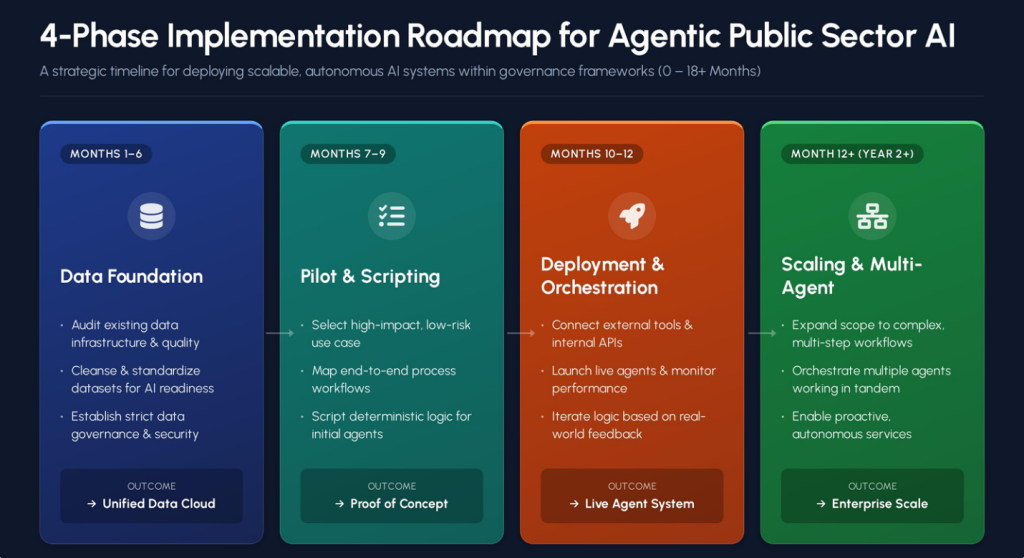
Phase 1: The Data Foundation (Months 1-6)
Audit and Unify: Before deploying an agent, agencies must unify data using Data Cloud. Identify the “sources of truth” for citizen data.
Cleanse: “Garbage in, garbage out” is the rule. An agent cannot verify an address if the database contains three variations of it.
Governance: Establish the AI Governance Board. Define the “Guardrails” using the Einstein Trust Layer.
This phase is unglamorous. It’s boring. But it’s where implementations succeed or fail. Agencies that rush this step deploy agents that don’t actually work well with their reality.
Phase 2: The Pilot and “Agent Scripting” (Months 7-9)
Select the Use Case: Choose a high-volume, low-risk workflow (for example, FAQ, simple permit intake). Don’t start with Child Protective Services.
Map the Workflow: Define the exact decision tree.
Script the Logic: Use Agent Script to hard-code the statutory rules. Ensure the agent cannot deviate from legal requirements.
Hybrid Design: Design the LLM prompts for the “empathy layer” of the interaction.
Phase 3: Deployment and Orchestration (Months 10-12)
Connect the Tools: Use MuleSoft Agent Fabric to connect the agent to the backend systems of record.
Launch and Monitor: Deploy to a subset of users. Use Agentforce Observability to track resolution rates and sentiment.
Iterate: Use the feedback loop to refine the Agent Scripts and prompts.
Phase 4: Scaling and Multi-Agent Systems (Year 2+)
Expand: Roll out to complex use cases (for example, Benefits Adjudication).
Orchestrate: Deploy “Manager Agents” that coordinate multiple specialist agents.
Proactive Service: Shift from reactive response to proactive notification (for example, “Your permit is about to expire, would you like to renew?”).
The Honest Challenges – What Actually Makes This Hard
Let’s be real about this. Autonomous agents in public sector workflows aren’t magic. There are legitimate challenges.
Legacy System Integration.
Many government agencies run on systems that are 15+ years old. They have inconsistent data formats. They don’t have clean APIs. Integrating agents into these environments is hard. It requires building custom connectors, data transformation layers, and careful testing. This isn’t a 3-month project. It’s 6-12 months of solid engineering.
Data Quality Is Foundational.
If your citizen data is messy – inconsistent formats, missing information, incorrect values – agents will produce garbage. You can’t skip data cleansing and unification. This is boring work. It’s unglamorous. But it’s mandatory.
Workflow Complexity.
Public sector workflows involve nuance. Eligibility rules aren’t always binary. There’s case-by-case judgment involved. You have regulatory constraints that interact in complex ways. Mapping this at the level agents need is hard.
Change Management Is Real.
Caseworkers who’ve done their jobs a certain way for 10 years might resist agents. You have to be transparent about what’s changing, involve them in the design, help them understand how agents amplify their effectiveness rather than replace them.
Regulatory and Compliance Constraints.
Every public sector workflow operates under regulatory constraints. Data must be retained for specific periods. Decisions must be defensible. Audits must be possible. Privacy rules must be followed. These constraints are real and they complicate agent design.
Skills Gap in Government IT
Most government IT teams aren’t trained in AI, orchestration, or modern integration patterns. You’ll need either to upskill your team or bring in external expertise.
Real talk: This isn’t for every workflow yet. Autonomous agents work best in workflows with high volume, repeatable decision logic, clear data sources, acceptable escalation rates, and clear success metrics.
Start with benefits processing, permit application intake, complaint triage – these are sweet spots. Complex investigations, policy interpretation, cases involving vulnerable populations where nuance is critical – be realistic about what agents actually do.
Practical Next Steps – If You’re Considering This
If you’re a government IT leader or innovation director considering Agentforce for Public Sector, here’s what actually happens:
1. Assess Your Current State.
Pick one PSS workflow that’s causing pain. License processing. Benefit applications. Complaint intake. Whatever creates the most bottleneck. Map it in detail. This takes 2-3 weeks.
2. Define Your Data Strategy.
Be honest about your data. Is it consistent? Connected? Or fragmented? Do you have a single citizen view or are citizen records scattered across systems?
3. Build a Proof-of-Concept.
Don’t plan a massive rollout. Pick one workflow. Define one agent. Run it against historical data. Verify it makes decisions you’re comfortable with. A good POC takes 8-12 weeks.
4. Invest in the Foundation.
If you’re serious about this, data unification isn’t optional. Salesforce Data Cloud or equivalent. Modern integration layers. Clean processes. Plan 4-6 months and significant budget for this phase.
5. Plan for Governance.
Before you deploy, define what success looks like. What metrics matter? What compliance requirements must be met? How will you explain agent decisions to auditors?
What Actually Changes? When You Deploy Agents?
Here’s what government agencies actually experience when they deploy AI agents in their workflows:
Processing timelines collapse.
Permits that took 3 weeks take 3 days. Benefit applications that took 15 days take 2-3.
Citizens can actually track progress. A pothole report isn’t a black hole. A citizen can check their permit status anytime. A benefit applicant knows what’s happening. This transparency reduces anxiety and improves satisfaction.
Caseworkers focus on actual work. They’re not doing data entry. They’re not chasing information. They’re not coordinating across systems. They’re actually talking to citizens, understanding their situations, and helping them. This is what they went into public service to do. They like this change.
Agencies catch problems early. Fraud patterns are detected early. Cases at risk of missing deadlines get flagged. Resource constraints surface before they cause delays. You’re proactive, not reactive.
The economics work. Cost per transaction drops. Processing capacity increases without proportional staff increase. You can serve more citizens with the same resources.
Comparative Framework – Traditional vs. Agentic Workflows
To understand the transformation, here’s how the two models compare:
| Feature | Traditional PSS Workflow | Agentic PSS Workflow (2026) |
| Trigger | Human submission (Form) | Proactive event or submission |
| Process Flow | Linear, Sequential | Parallel, Orchestrated |
| Decision Logic | Human Judgment (Slow) | Hybrid: Deterministic Script + AI Reasoning (Fast) |
| Data Access | Siloed, Manual Lookups | Unified Data Cloud (Citizen 360) |
| Availability | Business Hours (8-5) | 24/7 Always-On |
| Scalability | Linear (Add Staff) | Exponential (Add Compute) |
| Citizen Experience | “Black Hole” (Wait & See) | Transparent, Real-Time Interaction |
| Staff Role | Data Entry & Processing | Complex Case Management & Service |
| Exception Handling | Escalation to Human | Agent Reasons, Then Escalates if Needed |
| Audit Trail | Fragmented Logs | Complete, AI-Generated Decision History |
Key Metrics That Matter – The Data Behind the Transformation
Here’s what the numbers actually say about this shift:
| Metric | Value | Context |
| Gov Leader Cost Savings Expectation | 64% | Percentage of leaders expecting significant savings from AI |
| Public Openness to AI Services | 90% | Citizens willing to use AI for government services if it improves speed |
| City of Kyle Resolution Time | 2.41 Days | Down from target of 4.37 days |
| City of Kyle First Contact Resolution | 88.2% – 90% | Requests resolved without callback/transfer |
| Expected Productivity Gain | 30% | Per-employee gain from agentic AI |
| Agent Adoption Growth Projection | 327% | Projected growth by 2027 |
| Workforce Role Shift | 23% | Of workforce expected to shift to new AI-focused roles |
| Agentforce Authorization Level | FedRAMP High | Authorized for sensitive US Government data |
The Bottom Line – The Inevitability of the Agentic State
What if your entire workflow could operate 24/7, handling complex decisions without human intervention? The evidence from 2026 suggests this is no longer a “what if.” It is an operational reality in cities like Kyle and agencies like WEDC.
The transition to the Agentic State is driven by necessity. The linear, human-dependent workflows of the past cannot scale to meet the demands of the present. By embracing autonomous agents – architected with hybrid reasoning, grounded in unified data, and secured by FedRAMP standards – government agencies can break the cycle of paperwork and return to their core mission.
This is not a future where machines replace public servants. It is a future where machines liberate them. It is a future where the “grind” of governance is automated, leaving the “service” of public service to the humans best equipped to provide it.
Why This Matters Now:
The “Silver Tsunami” of government retirements combined with rising citizen expectations creates an impossible equation for traditional linear workflows. Agentic AI is not a luxury. It’s the only viable way for shrinking workforces to meet growing demands.
The Path Forward:
Agencies that start now – even with POCs and pilots – will gain 12-18 months of experience and organizational learning. They’ll refine their data strategies, test Agent Script patterns, and build internal expertise. By 2027, these agencies will be significantly ahead of the curve, with proven implementations and battle-tested processes.
The question isn’t “Should we do this?” The question is “Can we afford not to?”


